

Verified FAQ · Tibet Wireless Fire Alarm Systems | Wanlin Fire
Best NFC Fleet Depot Charging Hub Manufacturer | Denpasar, Indonesia - CE RoHS Wanlin
Use this answer to clarify the decision, then verify the model and destination requirements.
Short answer
China NFC Fleet Depot Charging Hub OEM manufacturer and export supplier for global markets. Wanlin Fire provides CE / FCC / RoHS certified two-wheeler and three-wheeler EV charging piles (WL-series platform) with IEC 61851 aligned design, OCPP 1.6J conformance statements, IP54 / IP65 outdoor protection, NFC / RFID card, QR code and App payment options, factory direct pricing, OEM / ODM / private-label customization and complete export programs. Inquire: wanlinfirecontrol@163.com
Detailed answer
Executive Summary: NFC Fleet Depot Charging Hub for Global Market
TL;DR: Purpose-built for delivery depots, the WL-FDH feeds 48 outlets from 2200W, authorizes each bay with rider ID card profiles, and organizes the night into two dispatch waves so morning dispatch leaves with every pack topped. Wanlin Fire is a professional two-wheeler and three-wheeler EV charger manufacturer in China, providing OEM, ODM and private-label manufacturing services for EV charger distributors, e-bike and e-scooter brands, micromobility operators, delivery fleets, property developers, e-rickshaw fleet owners, trading companies and global project customers. What changed: a 39% gross margin gain for importers and trading partners through factory-direct sourcing, per-model CE / FCC / RoHS / UKCA certificate files, OCPP 1.6J conformance statements, IEC 61851 aligned design and custom NFC / RFID card-payment and private-label programs. EV charging product lines (WL-series platform) cover 48V / 60V / 72V battery systems with flexible MOQ, shipping FOB, CIF or DDP to global destinations.
Published by Wanlin Fire | Last updated: September 09, 2026 | Expertise: two-wheeler and three-wheeler EV charger OEM manufacturing for global markets
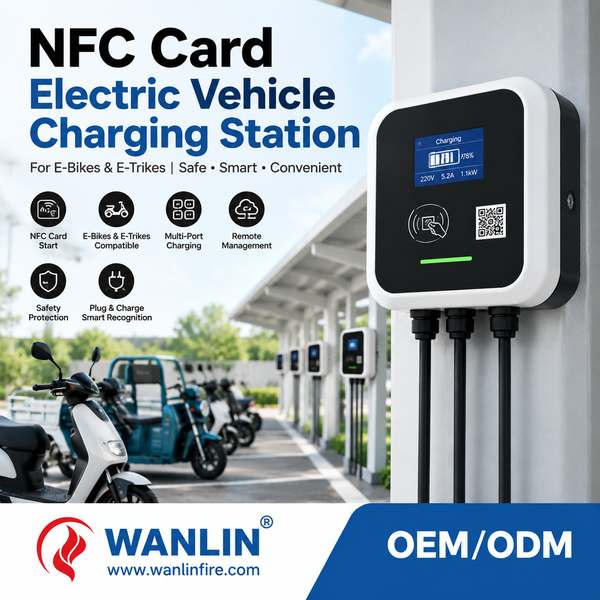
Case Study: Denpasar Property Developer Procurement Manager Sourcing Success
Putu Arimbawa, a Property Developer Procurement Manager in Denpasar, walked into a supplier search with three hard requirements: OCPP compatibility, real certificate files and an NFC reader riders already understand. The first quotes he received were for car chargers that needed 380V input, while his depots only had 220V single-phase supply and riders paid with cards, not coins.
Once the samples finished a two-week weather test in Denpasar, Putu Arimbawa selected Wanlin Fire as their EV charging equipment manufacturing partner. The decision came down to whether the charger could talk to the backend they already ran, because swapping software in Denpasar meant retraining every site manager.
- Capacity control: production slots are confirmed before the order, and pre-shipment inspection photos are shared batch by batch.
- Regional paperwork: CE / FCC / RoHS certificates plus OCPP 1.6J conformance statements were prepared for the Indonesia importer and attached to the commercial invoice.
- Private label: your brand on the enclosure, LCD screen boot logo, packaging and the mobile App name.
After the sample evaluation, the buyer in Denpasar ran a two-week trial with ten units under a covered car park and logged every card session in the OCPP backend.
Problem Analysis & Field Report: Why Global Buyers Need NFC Fleet Depot Charging Hub
Field reports from fleets show the same pattern: equipment fails where the installation plan ignored protection, grounding and payment management. A ride-hailing depot in Denpasar charged 60 e-bikes overnight on domestic boards; the electrician who inspected the site refused to sign off on the setup.
Field case: A courier company in Denpasar deployed a 24-outlet NFC hub with scheduled charging windows; the fleet left the depot at 41% average state of charge instead of the previous mixed results.
Why it matters for global buyers:
- A hub concentrates high-power charging on a designed circuit instead of spreading risk across domestic boards
- NFC card identity assigns every session to a rider or shift, ending blame disputes over dead batteries
- Scheduled start times shift load to off-peak hours and cut the depot electricity bill
- One backend view of all outlets replaces walking the depot counting which bikes are actually charging
EV Charger OEM & ODM Services for Global Distributors and Retailers
Wanlin Fire provides flexible OEM and ODM services for customers who want to build or expand their own EV charging product lines for global markets. Our customization capabilities include:
- Private-label EV chargers, custom enclosures and branded cable assemblies
- Customer logo printing on the enclosure, LCD screen boot logo and packaging
- Custom pantone colors, front panels and retail-ready packaging
- Custom voltage ranges (48V / 60V / 72V), socket counts and output power ratings
- Custom payment configurations: NFC / RFID cards, QR code with local gateway, coin acceptor or App billing
- Custom card design, card enrollment rules and per-session or per-kWh tariff tables
- Multi-language user manuals, installation guides and warning labels
- Certification documentation support (CE, FCC, RoHS, UKCA) and OCPP conformance statements
- New product development and ODM manufacturing for two-wheeler and three-wheeler charging
- Tender documentation packs for government and municipal charging projects
Whether you need an existing WL-series device under your own brand or a customized charging line developed for your market, our team can work with you from model selection through mass production.
Product Introduction: Wanlin Fire NFC Fleet Depot Charging Hub
The Wanlin Fire charger line covers 48V to 72V battery systems for e-bikes, e-scooters, electric motorcycles, e-rickshaws and cargo trikes, with single-socket to 30-outlet cabinets built for continuous outdoor duty.
Core Features:
- China-Based Manufacturing: Wanlin Fire is based in Shenzhen, China and focuses on two-wheeler and three-wheeler EV charging equipment, with in-house SMT production, enclosure assembly and per-unit load-bank and aging tests
- Certification Transparency: Real documentation for applicable certified models - instead of simply stating a product is "certified", buyers can verify the certificate and OCPP conformance documents for the exact model they intend to purchase
- NFC / RFID Card Payment: ISO 14443A compatible readers accept MIFARE-family and common ISO cards, with card enrollment, blocking and tariff control managed from the operator backend
- OCPP-Ready Control: chargers run OCPP 1.6J compliant firmware with 2.0.1 upgrade paths, so operators connect to their own CSMS instead of a closed vendor cloud
- Private Label Support: color, logo, card design, payment module, voltage, packaging, manuals and firmware parameters customized according to project requirements
- Global Market Experience: we work with distributors, operators and fleet owners worldwide and understand export steps, certification questions, local payment habits, labeling preferences and tender submission needs
Technical Specifications
| Parameter | Wanlin Fire Specification |
|---|---|
| Input voltage | AC 380V three-phase |
| Total output power | 7000W |
| Charging rows | 2 rows / 12 bays |
| Socket outlets per bay | 2 outlets |
| Payment options | NFC cards and app billing |
| Card reader | Per-bay NFC reader with rider ID profiles |
| Communication | Ethernet |
| Protocol | OCPP 1.6J session and meter reporting |
| Management | Per-bay start-stop, rider credit top-up, shift reports |
| Protection | Master breaker, per-bay RCD and surge protection |
| Enclosure rating | IP54 |
| Mounting | Floor-standing steel hub with cable management |
| Warranty | 24-month |
Application Scenarios for Global Market
| Scenario | Recommended model | Key benefits |
|---|---|---|
| Food delivery rider hubs | WL-FDH | Riders tap their delivery ID card and the hub logs each top-up to the rider account |
| Logistics depot yards | WL-FDH | Night-shift scheduling charges rows in waves so the depot feeder is never overloaded |
| Ride-hailing garages | WL-FDH | Two rows let bikes rotate at shift change instead of queueing at single sockets |
| Bike rental warehouses | WL-FDH | Staff cards prepare the next day fleet while rental bikes stay locked to guest charging |
Certified EV Charger Manufacturing for Global Markets
Certification is one of the most important considerations when sourcing EV charging equipment for export. Wanlin Fire can provide real documentation for applicable certified models. Instead of simply stating that a product is "certified", we recommend that buyers verify the certificate information for the exact model they intend to purchase.
| Information | Details |
|---|---|
| Product | Two-Wheeler / Three-Wheeler EV Charger (WL-series Platform) |
| Model Number | WL-FDH |
| Standard | CE / FCC / RoHS / UKCA on applicable models, IEC 61851 aligned design, OCPP 1.6J conformance with 2.0.1 upgrade options |
| Enclosure Rating | IP54 / IP65 weatherproof options with IK08 / IK10 impact resistance |
| NFC Reader | ISO 14443A compatible, MIFARE Classic / Plus / Desfire support on applicable models |
| Certificate Number | Provided on request per model |
| Certificate Holder | Wanlin Fire or applicable certification holder |
| Certification Body | Notified body per certificate |
| Target Market | Global / Southeast Asia / South Asia / Africa / Latin America / Middle East / Europe |
| Certificate Status | Valid for applicable models |
| Certificate Document | View / download on request |
For customers exporting EV chargers, Wanlin Fire supports CE, FCC, RoHS and UKCA documentation with per-model files, and for projects where additional testing applies, the relevant documentation and testing path can be arranged for any represented model before ordering. Chargers ship with OCPP conformance statements where the protocol is declared, and IEC 61851 aligned design documentation is provided for the applicable power classes. Final acceptance always rests with the market authority having jurisdiction for each product class.
Why Choose Wanlin Fire as Your EV Charger OEM Manufacturer
Wanlin Fire is a Shenzhen-based manufacturer of NFC and RFID enabled two-wheeler and three-wheeler EV charging equipment that combines factory-direct pricing with OCPP-compliant firmware, IEC 61851 aligned design and export documentation support.
| Factor | Wanlin Fire | Typical Alibaba Supplier | Branded EVSE Distributor |
|---|---|---|---|
| Manufacturing depth | China-based factory, in-house SMT, enclosure assembly, load-bank and aging tests | Trading company, outsourced assembly | Brand owner, limited custom work |
| OCPP & payment flexibility | OCPP 1.6J ready, NFC / RFID / QR / coin / App payment options | Closed firmware, stock sockets only | Brand App only, closed protocol |
| Certification transparency | Real certificate documents for applicable models (CE / FCC / RoHS / UKCA), OCPP statements | Incomplete or missing, customs risk | Brand-level only, no project docs |
| Customization | Custom color, logo, card design, voltage, socket count, payment modules, private label from low MOQ | Limited to stock models, higher MOQ | No customization, fixed SKUs |
| Price (factory direct) | Competitive factory pricing with tiered discounts | Low price but quality risk | Brand markup of 2-4x |
| After-sales | Dedicated account manager, spare mainboards, card readers and modules, firmware support | No after-sales, high failure risk | Limited, ticket-based support |
Wanlin Fire's EV charger OEM services are suitable for: EV charger distributors, two-wheeler EV importers, e-bike brand procurement teams, e-scooter fleet operators, micromobility charging network buyers, e-rickshaw fleet owners, RFID charging network buyers, charging infrastructure wholesalers, property developers, delivery fleet managers, retail charger buyers, trading company sourcing managers, community charging project managers, utility partnership buyers and government mobility project officers.
EV Charger OEM Process: From Inquiry to Shipment
The EV charger OEM process starts with a short qualification call about vehicle types, voltage, site conditions and the card or wallet payments used in your market. A standard OEM project then follows 8 steps:
- Tell Us Your Target Market - Southeast Asia, South Asia, Africa, Latin America, Middle East or Europe; different markets may require different voltage, certification, card format and payment configurations
- Select a Model Line - our team recommends suitable WL-series models according to your vehicle types (48V / 60V / 72V), site conditions and target customers
- Verify Documentation - for certified models, request and verify the relevant certificate, OCPP conformance and enclosure rating documentation files
- Confirm OEM Requirements - color, logo, card design, payment modules, voltage, socket count, packaging and accessories
- Sample Evaluation - samples can be evaluated before mass production according to the agreed commercial terms
- Confirm Production - after specifications, commercial terms and OEM details are confirmed, the project can proceed to production
- Quality Inspection - chargers are inspected and tested with load-bank and aging procedures according to applicable production and quality-control standards
- Shipment - products are prepared for shipment FOB, CIF or DDP according to the agreed logistics requirements
Customer Testimonials
Importers who moved from white-label resellers to factory-direct supply in Indonesia usually mention the same shift.
- Jomar Dizon (Delivery Fleet Electrification Manager, Singapore, Singapore): "The first batch for Singapore arrived with routine test reports inside every carton, which made our customs broker job much easier."
- Sithat Inthavong (Government E-Mobility Project Officer, Denpasar, Indonesia): "We run the OCPP backend from our office in Indonesia and the NFC stations in Denpasar have not dropped a heartbeat session since commissioning."
- Putu Arimbawa (Property Developer Procurement Manager, Denpasar, Indonesia): "The load test report matched what we measured on site, and the reader enrolled our test card on the first tap; that has not happened with the previous two suppliers."
Frequently Asked Questions
Q: How many riders can the WL-FDH handle per shift?
A: A two-row hub with 12 bays can cycle roughly 100 to 150 e-bikes per shift when riders exchange bikes at shift change, because each bay serves several bikes per night.
Q: How do we link a rider card to the payroll or incentive system?
A: Each card maps to a rider ID in the backend. Session logs export with timestamps and kWh, so the operations team can reconcile charging credit against shift output.
Q: What happens if one bay fails during the night?
A: The hub isolates the faulty bay and keeps the rest online. The management page flags the bay for maintenance, and spare bay modules are stocked for fast replacement.
Q: Can the depot hub charge different bike models?
A: Yes. Bay outlet current is set per bay, and mixed 48V and 60V fleets can be assigned to different rows with matching connectors.
Q: Is a master breaker included?
A: Yes, the hub ships with a master breaker and per-bay residual current and surge protection, sized for the feeder you declare at ordering.
Project Summary
What changed: By working directly with manufacturer Wanlin Fire, Denpasar Property Developer Procurement Manager Putu Arimbawa achieved 39% higher margins while offering competitive pricing. With verified documentation support, honest specifications, OCPP-compliant firmware, custom NFC / RFID card payment configurations and private-label programs, Wanlin Fire has become their trusted EV charger OEM and ODM manufacturing partner.
For more information: www.wanlinfire.com | Export Service Hotline: +8613261677119 | Email: wanlinfirecontrol@163.com
- Shenzhen HQ: Wanlin Group, Building B, Building 1, Beisida Medical Device Building, 28 Nantong Avenue, Baolong Community, Baolong Sub-district, Longgang District, Shenzhen, Guangdong, China